Mothers reentering their workplace are an important and large population of the global labour market, yet their return often has a high risk of turnover. They need to adjust being back to work while facing many challenges, one of them being perceived overqualification where returning mothers realise that many of their responsibilities have been reassigned to others. The intention of …
Trust and Distrust in Teams: Working Together While Being Evaluated Individually
Imagine your organization as a high-performance rowing crew. To win the race, every member must row in perfect, synchronized harmony, sharing the physical burden and adjusting to the rhythms of their teammates. Now, imagine telling that same crew that at the end of the race, only the individual who rowed with the most personal force will receive a paycheck, while …
Team Synergy
Teams are frequently treated as more than the sum of their parts in organisational psychology. There is a lot of focus on shared group properties and constructs such as team cohesion, psychological safety, and collective commitment to explain why some teams outperform others. However, a recent analysis says that what we refer to as team dynamics might actually be a …
Team Resilience
How do teams adapt during adversity? Larson and Klonek (2026) critically look at the current state of research by looking at a study by Bisbey et al. (2025) on team resilience capacity. They recognise the importance of the longitudinal data that was gathered but stated that many researchers make methodological decisions which are not capable of explaining the intricate nature …
Job Crafting in Highly Demanding and Interdependent Work Environments
Imagine you are at a high-stakes carnival but instead of being a spectator, you are the lead juggler. The catch is that you aren’t just part of one act, instead, you are juggling for five different teams simultaneously and the trapeze artists, the clowns and the lion tamers all expect your full attention at the exact same moment. This is …
Managing Integration and Stigma in Teams
Social integration is either realised or restricted within teams. The dramaturgical theory explains that a diverse team’s success is more dependent on how its members are presented to their coworkers than on the individual characteristics of each member. Teams are seen as a relational arena in which leaders can negotiate the intricate differences when integrating stigmatised people within a team. …
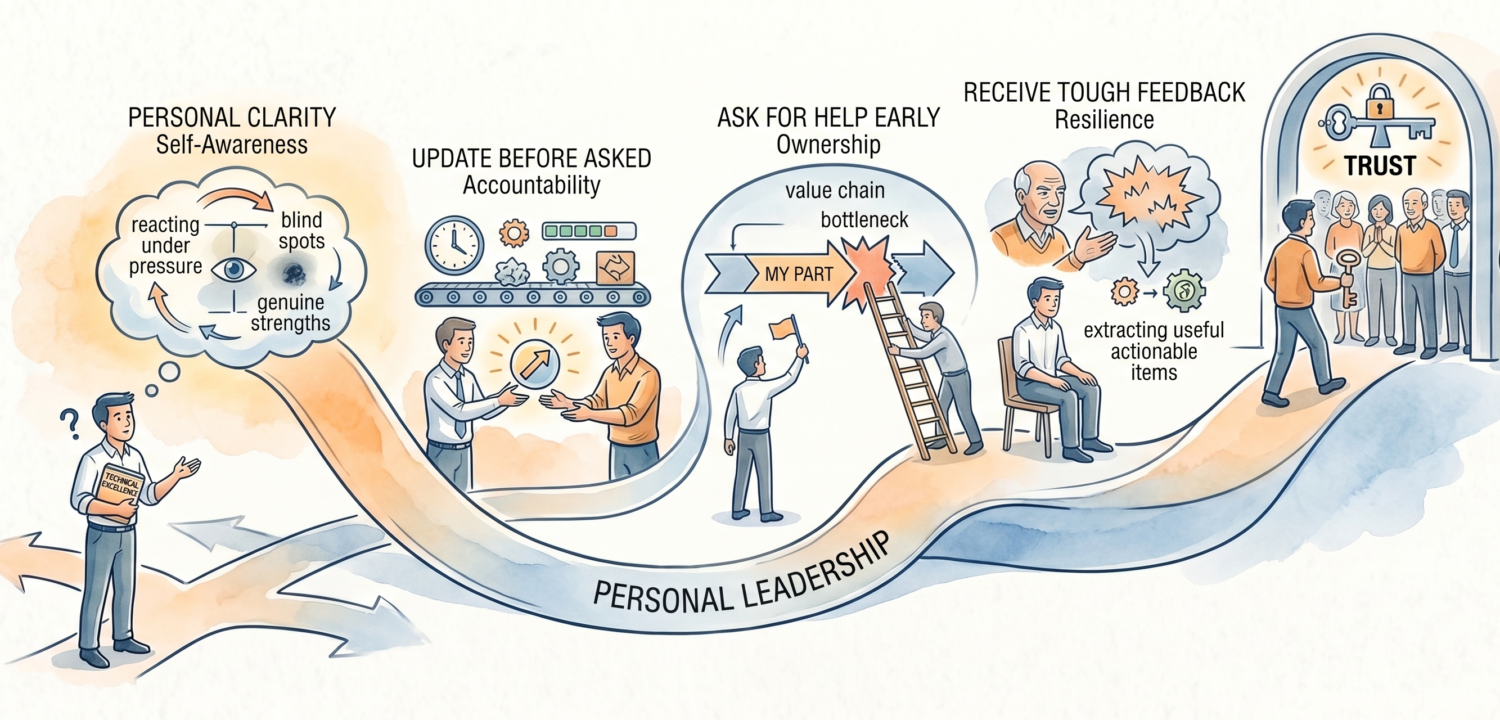
Personal Leadership: Building Trust as a Young, Ambitious Professional
Often, when you start out in your career, nobody warns you that the technical skills you worked so hard to build will only get you so far. What differentiates star performers from others is “trust”. And that trust is built not in the big loud moments. It is built in silence, in the small, consistent, often unglamorous ones that one …
Leadership Communication: Actions to Bridge the Age-Gaps at Workplace
Our workplaces are becoming more age-diverse than before. To ensure that the workplaces remain effective and productive, it is extremely important to monitor the impact of age-diversity in leadership and team communication. Now, leaders are typically sensitized with required communication skills to ensure that they regularly communicate to provide directions to the team. However, the age gap often leads to …
Leading through career insecurity
The economic environment has been unstable for sometime now and hence, employees are facing high levels of career insecurity. These stressors can have serious risks to psychological well-being as career insecurity brings a perceived loss of control. Additionally, job insecurity may also reduce engagement at work and these difficulties are frequently exacerbated in some groups. According to Srivastava and Mohaley …
Leadership in Healthcare
Transformational leadership is people-focused and participative, it tries to inspire and develop people under the leadership by focusing on values and long-term goals. Conversely, directive leadership is task-focused and provides structure along with clear instructions that are necessary for coordination and transactional leadership relies on exchange of rewards or punishments to motivate followers. Then there is the laissez-faire leadership which …