Social integration is either realised or restricted within teams. The dramaturgical theory explains that a diverse team’s success is more dependent on how its members are presented to their coworkers than on the individual characteristics of each member. Teams are seen as a relational arena in which leaders can negotiate the intricate differences when integrating stigmatised people within a team. …
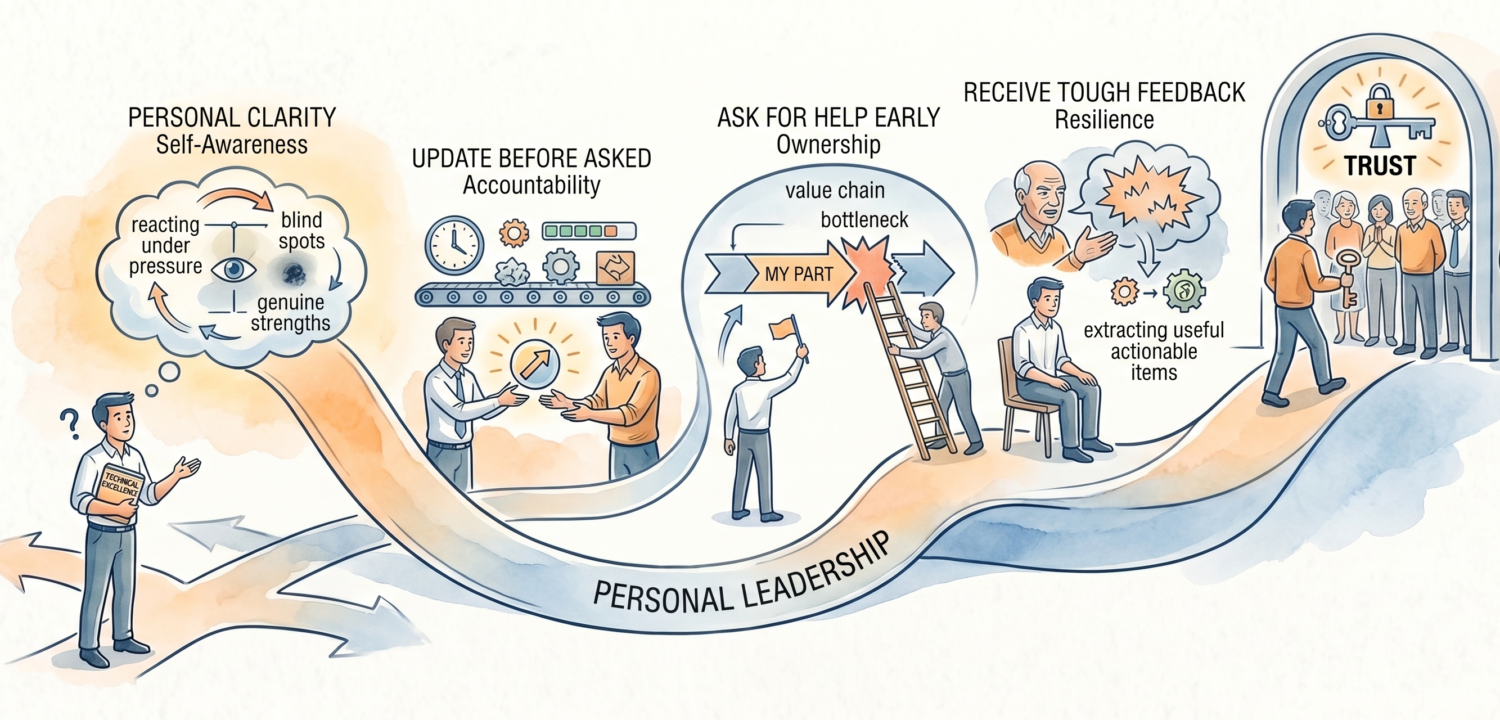
Personal Leadership: Building Trust as a Young, Ambitious Professional
Often, when you start out in your career, nobody warns you that the technical skills you worked so hard to build will only get you so far. What differentiates star performers from others is “trust”. And that trust is built not in the big loud moments. It is built in silence, in the small, consistent, often unglamorous ones that one …
Leadership Communication: Actions to Bridge the Age-Gaps at Workplace
Our workplaces are becoming more age-diverse than before. To ensure that the workplaces remain effective and productive, it is extremely important to monitor the impact of age-diversity in leadership and team communication. Now, leaders are typically sensitized with required communication skills to ensure that they regularly communicate to provide directions to the team. However, the age gap often leads to …
Leading through career insecurity
The economic environment has been unstable for sometime now and hence, employees are facing high levels of career insecurity. These stressors can have serious risks to psychological well-being as career insecurity brings a perceived loss of control. Additionally, job insecurity may also reduce engagement at work and these difficulties are frequently exacerbated in some groups. According to Srivastava and Mohaley …
Leadership in Healthcare
Transformational leadership is people-focused and participative, it tries to inspire and develop people under the leadership by focusing on values and long-term goals. Conversely, directive leadership is task-focused and provides structure along with clear instructions that are necessary for coordination and transactional leadership relies on exchange of rewards or punishments to motivate followers. Then there is the laissez-faire leadership which …
Leaders under pressure: How supervisors’ negative family events translate into (or undermine) family-supportive behaviors
Imagine a leader not as a flawless machine but as a captain of a ship. When a storm brews at their home port, does it make them more empathetic or a distracted and irritable one? For years, management experts have debated whether home-life stress drains a leader’s “battery” or sensitizes them to the struggles of their team. A study by …
Transfer of Leadership
When a leader leaves an organisation the focus often comes on the paperwork like the updated organisational chart or new email signatures. But the most crucial part of any transition is not handing the position to someone else, rather it is the aftershock that is felt psychologically by everyone who is involved in the company which causes resistance for the …