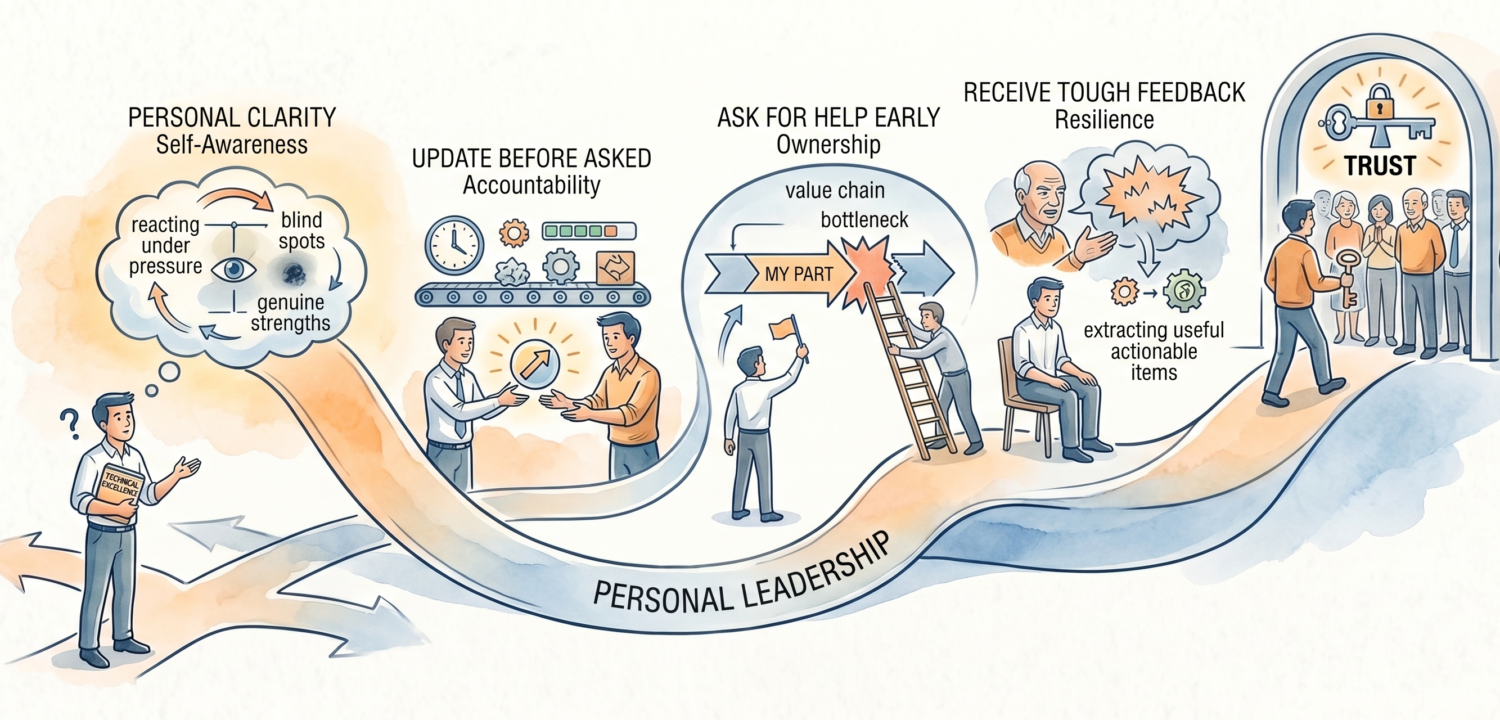
Often, when you start out in your career, nobody warns you that the technical skills you worked so hard to build will only get you so far. What differentiates star performers from others is “trust”. And that trust is built not in the big loud moments. It is built in silence, in the small, consistent, often unglamorous ones that one feels nobody is watching.
I learned this over time, and mostly the hard way.
Begin With Clarity
Everything starts with clarity — and clarity begins within.
Of all the things I am mentioning in this piece, this is probably the one that is most vague, but also the most critical.
Younger years in professional life are often marked by the dissonance between the ideal ideas learnt in the classroom and the harsh realities of professional expectations. Add to that, several academic programs have a significant disconnect with real workplace skills.
A perfectly imperfect cocktail of chaos, confusion, and frustration – while still being expected to learn and deliver.
At this stage, it is important that you have a strong working understanding of yourself: how you react under pressure, where your blind spots are, how do you learn, what you tend to avoid, and what you are genuinely good at.
This personal clarity will reflect in the workplace as emotional maturity and stability. Further, in professional conversations, the habit of seeking clarity translates into the habit of asking questions – not as class participation, but to seek genuine clarity about what is expected of an assignment, what success looks like, and what the context is.
It signals curiosity and intentionality.
Update Before You Are Asked
Here is something that separates the professionals that leaders trust from others – they communicate proactively, especially when things are not going to plan.
Delays happen. Things go wrong. In the real world, projects slip, dependencies fail, and circumstances change. None of that, by itself, destroys trust. What destroys trust is silence — the manager who finds out something went sideways not from you, but from someone else, or worse, from the outcome itself.
It signals accountability.
Ask for Help Before It Becomes a Crisis
Closely related to proactive communication is learning to raise a flag early. Not every bottleneck needs to become bad news – but it will, if you wait too long. Many young professionals stay silent when they hit a wall because they fear looking incapable or because they think it not their job to raise this “specific” red flag. The result is that a solvable problem becomes an unsolvable one, and trust erodes in the process.
Asking for help early or highlighting something that you anticipate may go wrong in the value chain is not a weakness or overstepping. It shows that you care about the outcome and just about your part in it.
It signals ownership.
Learn to Receive Tough Feedback
Life is not rosy. Careers are not rosy. At some point, you will receive feedback that is uncomfortable, maybe even so brutal that it makes you question your own capabilities. But trust me, as someone who has dealt with brutal feedback in the early years of my career: when dealt with correctly, it sets you up for success.
The professionals I have seen build lasting credibility are those who can receive difficult feedback without collapsing, deflecting, or getting defensive. They listen, they sit with it, they extract what is useful, and they act on it. They do not avoid the conversation, make ingenuine commitments to rush the topic or let the feedback get to their self-esteem.
They are excellent at understanding that feedback is about “what and how they do at the job they are expected to do” and not a commentary on who they are as a person. They understand that it is often rooted in their present work performance and not a prediction of how far they can/cannot go. This takes practice. It takes emotional regulation. And it takes courage to separate actionable from all the mental chatter and really act on them.
Acting on feedback signals resilience, humility and learning agility.
The Skills That Will Always Win
As you grow in your career, something becomes increasingly clear: cognitive capability is the entry ticket, not the differentiator. The professionals who consistently rise are those who have learned to influence without a title, to regulate their emotions under pressure, and to deliver difficult messages in ways that land with impact rather than damage.
These are not soft skills. They are the hardest skills, because they cannot be studied for. They are built through experience, through self-reflection, and through the willingness to stay in uncomfortable situations long enough to learn from them.
Technical excellence will open doors. But it is these capabilities, anchored in self-awareness, accountability, and emotional intelligence, that will determine whether you are trusted enough for people to let you through them.
That is personal leadership. And it begins on day one.