
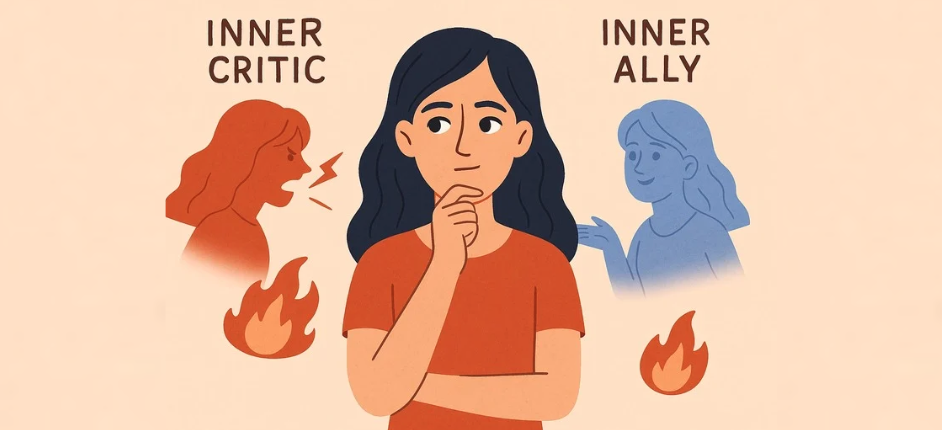
A lot of us have experienced that nagging inner voice that whispers, “Whatever you do , you will never be good enough,” or “You always mess things up,”This voice, often called the inner critic, can be persistent. While a certain level of self-evaluation helps us learn and grow, harsh and constant negative self-talk can become destructive, impacting self-esteem, productivity, and even mental health.
The inner critic is not just an occasional thought , it can turn into a pattern of self-sabotage. For many people, it shows up as perfectionism, chronic self-doubt, or a tendency to compare themselves unfavorably with others. If left unchecked, it can feed into stress, anxiety, or depression. Understanding this voice and learning to respond differently is an important step toward better psychological well-being.
Why Do We Have an Inner Critic?
From a psychological perspective, the inner critic often develops early in life. It may stem from internalized messages we absorbed from parents, teachers, or peers. For example, a child who repeatedly hears “You should try harder” might grow up interpreting even small mistakes as signs of failure. Over time, this voice becomes internalized and may operate automatically in adulthood.
Cognitive-behavioral psychology explains this process as automatic negative thoughts that operate subconsciously and are mental shortcuts that exaggerate flaws or risks while ignoring strengths and successes. Although these thoughts are not always based on facts, they feel convincing, which is why many people accept them without challenge.
How Negative Self-Talk Affects Daily Life
The inner critic imparts more influence than the mood , it shapes behaviors and choices. Some people avoid opportunities because they believe they are not capable enough. Others push themselves too hard in hopes of achieving unrealistic standards leading to burnout. Over time, this cycle can diminish resilience, reduce creativity, and make relationships harder to maintain. For instance, imagine preparing for a job interview. If the inner critic says, “You’re going to fail,” you may walk in feeling defeated before even starting. On the other hand, learning to reframe that thought into “I’ve prepared, and I’ll give it my best” creates space for confidence and calm.
Clinical Strategies to Tame the Inner Critic
While the inner critic cannot be silenced completely as it is part of being human, it can be managed. Here are some evidence-based strategies that psychologists often recommend:
- Notice and Name the Voice
Awareness is the first step. Many people don’t realize how frequently they engage in negative self talk. Try keeping a journal of recurring thoughts or give your inner critic a nickname. This helps create distance and reminds you that the voice is not your true self. - Challenge Cognitive Distortions
Negative self-talk often follows predictable patterns, such as “all-or-nothing thinking” (“If I’m not perfect, I’m a failure”) or “catastrophizing” (“If I make one mistake, everything will go wrong”). Identifying these distortions allows you to reframe them into more balanced thoughts. - Practice Self-Compassion
Instead of criticizing yourself for mistakes, respond as you would to a close friend , with kindness and understanding. For example, replacing “I’m so dumb” with “I made a mistake, but I can learn from this” will help build resilience in the long-term. - Use Evidence-Based Affirmations
Affirmations are most effective when they are realistic and grounded. Rather than saying “I am the best,” try “I have handled challenges before, and I can handle this too.” - Mindfulness and Grounding Techniques
Practices like mindful breathing, meditation, or grounding exercises help calm the nervous system and create space between you and your thoughts. This makes it easier to respond thoughtfully rather than react automatically. - Seek Support When Needed
If negative self-talk feels overwhelming or persistent, professional help can make a difference. Cognitive-behavioral therapy (CBT), compassion-focused therapy, and mindfulness-based interventions are especially effective in reducing the power of the inner critic.
Building a Healthier Inner Voice
Reframing the inner critic is not about silencing it completely but about cultivating a healthier internal dialogue. Over time, you can learn to shift from “I’m not enough” to “I’m learning and growing.” This mindset supports both personal and professional growth while reducing unnecessary stress. Remember, self-talk is powerful as it shapes how we feel, how we behave, and ultimately, how we see ourselves. By practicing awareness, compassion, and psychological strategies, we can transform the inner critic from a harsh judge into a supportive guide.
Quick Tips: Taming the Inner Critic
- Notice when negative self-talk shows up because awareness is key.
- Challenge exaggerated or distorted thoughts with facts.
- Replace harsh criticism with compassionate, friend-like words.
- Use realistic affirmations that build confidence gradually.
- Practice mindfulness to create calm and distance from thoughts.
Work Cited
- Beck, J. S. (2011). Cognitive behavior therapy: Basics and beyond (2nd ed.). Guilford Press.
- Gilbert, P. (2010). Compassion focused therapy: Distinctive features. Routledge.
- Neff, K. (2011). Self-compassion: The proven power of being kind to yourself. HarperCollins.
- Segal, Z. V., Williams, J. M. G., & Teasdale, J. D. (2018). Mindfulness-based cognitive therapy for depression (2nd ed.). Guilford Press.
- Shahar, B. (2015). The compassionate mind approach to confronting your inner critic. Constable & Robinson.
About the Author