
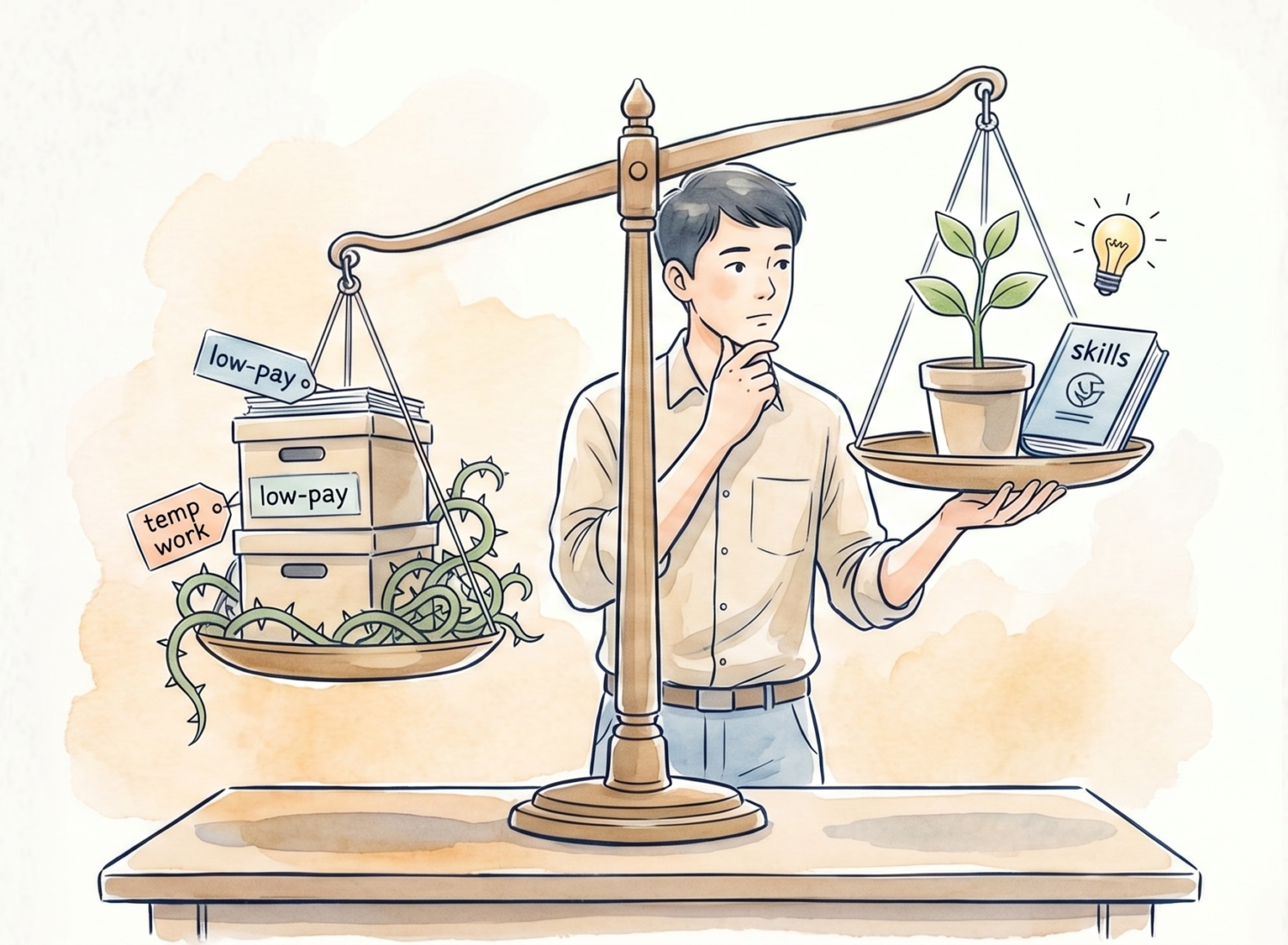
The feelings of underemployment for new employment form workers such as platform and gig workers creates both a risk and an opportunity. Underemployment here refers to the subjective experience of underused potential at work. It can either boost or damage the career satisfaction of employees depending on the perception of their skill, education, or the time that is being underutilised. This perspective becomes the catalyst of 2 different paths behaviourally and psychologically where one leads to undesirable career shifts while the other results in proactive growth.
On the one hand, underemployment often causes career transitions. These changes are often unplanned, they may be defensive and impact career satisfaction negatively. The job dissatisfaction is not about the job itself but about the cognitive evaluation of the employee of their situation, and this drives their subsequent actions such as job hopping.
On the other hand, perceived underemployment could increase job satisfaction if it motivates resource orchestration, where employees can integrate new skills and networks proactively in order to create value. This happens when workers view underemployment as a challenge to overcome by developing new skills.
However, the critical factor that influences these decisions is the self-clarity of employees. Low clarity is likely to make them switch jobs out of anxiety while high clarity empowers workers to turn the stress of underemployment into motivation. Employees could benefit from prioritising clarity and by career planning whereas, organisations could provide training opportunities along with promotion opportunities to retain talent while increasing their satisfaction and growth in their career.
Additionally, the government can help by offering training that fits new industries such as AI, improve pay systems, and increase social security. This includes improving digital platforms in the gig economy so that workers receive relevant information, training, career planning, and mental health support.
Overall, underemployment among new employment form workers is not inherently harmful or beneficial; its impact depends on how workers perceive and respond to it. Hence, when they are given direction by clear career self-clarity, underemployment can become a driver of skill development and long-term growth rather than a cycle of shifting jobs due to uncertainty about their career. This suggests that as new forms of work continue to expand, perception quietly becomes a powerful force in shaping professional journeys.
Food for thought: What has more influence on our experience at work: the situation we are in or the way in which we perceive it?
References
- Fu, C., & Wang, H. (2026). The double-edged sword effect of perceived underemployment on the career satisfaction of new employment form workers. Frontiers in Organizational Psychology, 3. https://doi.org/10.3389/forgp.2025.1686237