
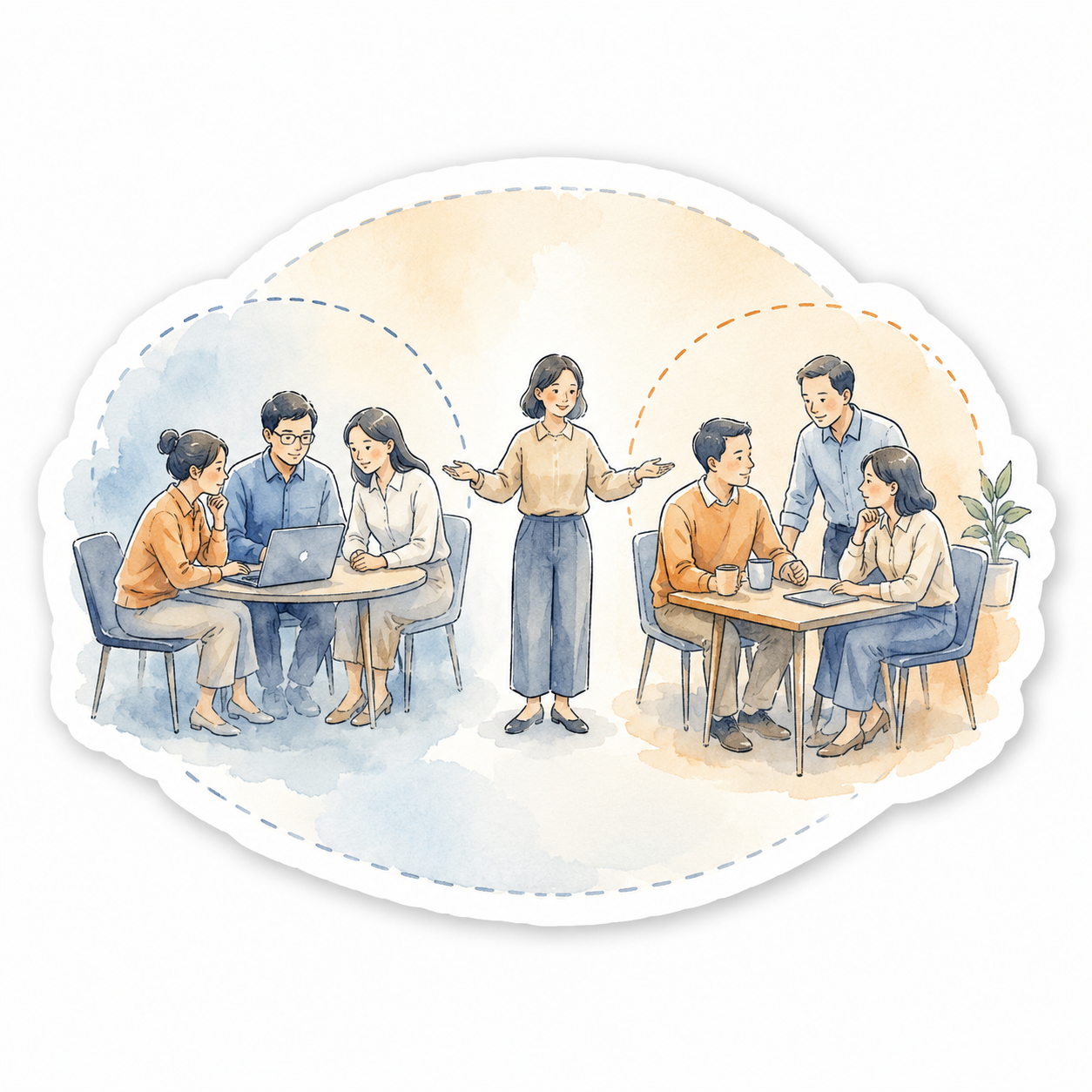
Many of us have probably seen it happening. After a team forms, subgroups tend to also form over time. All the people who have been in the company for long will sit together, analysts talk with other analysts, engineers with other engineers and so on. Employees who work remotely may become a group of their own and most of the time these subgroups are harmless, sometimes they may even be useful. However, sometimes there may be some issues in them that we cannot see which may shape trust and performance. This can be seen through some studies such as Tiede et al. (2021) and Moon et al. (2026) which looked at subgroups.
Moon et al. (2026) argued that subgroups aren’t fixed and that they change through many factors such as age, role, or tenure. Even networks matter, so here it refers to people who speak together for advice, information and who trust each other. They focused on it as it matters during change because formal redesigns doesn’t mean that relationships at work also automatically develop.
Another important insight can be seen in the study by Tiede et al. (2021). They found that demographic differences did not matter alone, instead whether or not people perceived the team to be divided into subgroups did. Hence, different backgrounds, roles or the location did not matter as much as people feeling like within their groups there are other groups which gives a feeling of “us” vs “them”.
All of this has practical implications for leaders during change. For example if an organization is introducing a new tech platform then they’ll have a tech team and a non-tech team. However, within these 2 groups also there can be divides between groups who are okay with the change and those who aren’t while feeling that the change was imposed upon them. Here, the leaders can reflect and ask questions like if they had communicated the change clearly or how the change might impact employees socially since such questions shift the focus from managing the process to managing the relationships between colleagues and teams.
Here even small actions can help such as inviting team members who don’t speak up much in early discussions instead of only involving them in the briefings after the discussion. Additionally, informal knowledge can be made available to all so that just one subgroup doesn’t know how things really work.
All in all, subgroups aren’t always harmful and they can give support and psychological safety during uncertainty. The challenge is only to prevent them from becoming rigid. So successful change will depend on not just if employees understand the new change but if they can still see themselves as part of an entire team.
Food for thought: If subgroups are unavoidable, should leaders try to reduce them, or simply make sure they do not turn into “us vs. them” divisions?
References
- Moon, J., Oh, C., Tsai, C., & Park, S. (2026). A framework for subgroup dynamics through the system Dynamics lens: an integrative review of the attribute and the network views. Journal of Organizational Behavior. https://doi.org/10.1002/job.70051
- Tiede, K. E., Schultheis, S. K., & Meyer, B. (2021). Subgroup splits in diverse work teams: subgroup perceptions but not demographic faultlines affect team identification and emotional exhaustion. Frontiers in Psychology, 12, 595720. https://doi.org/10.3389/fpsyg.2021.595720