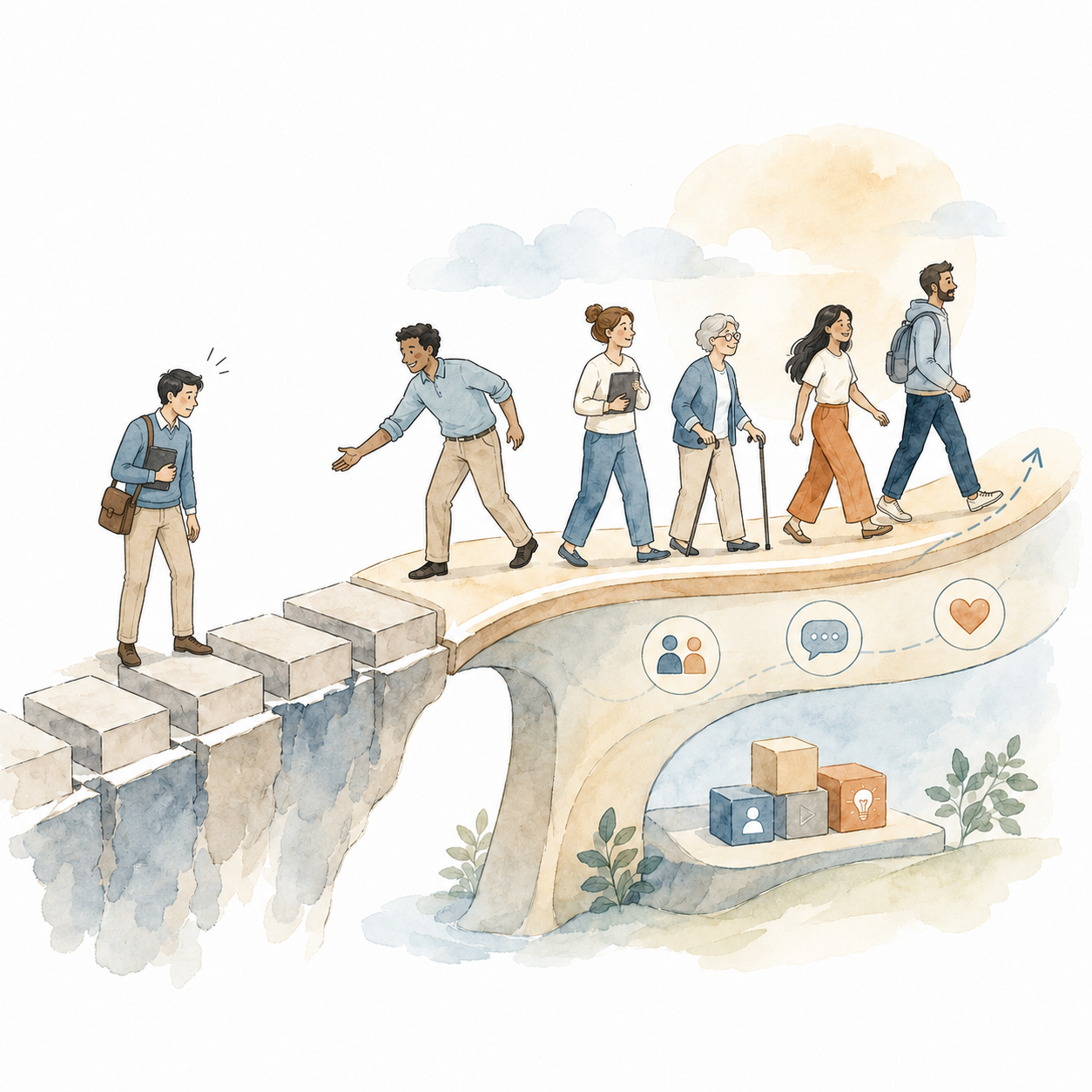
When footwear companies manufacture shoes, they don’t design a single “average” size and force everyone to wear it. And yet, when designing change in organisations, we often create a rigid “Standard Employee” framework and expect a diverse workforce to fit into the same mould.
When processes are too rigid employees are frequently left behind and this happens not because they lack competence or the ability to adapt, but because they are exhausting their energy trying to navigate a system that refuses to budge. This rigidity acts like brittle steel, forcing people to bend to its shape until they snap. True inclusive change, however, works like mouldable clay. It is strong enough to provide organizational structure, yet flexible enough to be streamlined into the realities of daily workflows.
We see a brilliant, real-world example of this clay-like adaptability in the biographical series Made in India: The Titan Story. In a standout scene, visionary leaders Mr. Xerxes Desai and Mr. Akash Dixit (played by Jim Sarbh and Vaibhav Tatwawadi) are determined to find the right engineers to build India’s pioneering watch brand. Their chosen recruitment task? Getting candidates to fix broken ceiling fans right there in the interview room.
While it sounds strange on the surface, it was a masterclass in how to design an inclusive process. They designed the assessment to be about raw, practical problem-solving, rather than forcing candidates through a standardized, purely theoretical interview format that inherently favoured smooth talkers.
Rewiring Training for Diverse Cognitive Styles
This philosophy of moulding the process around the person shouldn’t stop at recruitment, it must extend into how we train our people during times of change. Traditional corporate training operates on a huge, flawed assumption: that everyone learns at the exact same pace and thrives in the exact same environment. When organizations undergo major shifts, the default response is often to overwhelm teams with large volumes of information at once. According to Sweller’s Cognitive Load Theory, this data-dumping causes acute cognitive overload, leading to poor retention and universal frustration.
To make training truly inclusive, organisations must design learning materials to match human cognition through “chunking” (breaking big chunks into micro-learning modules) or learning complex materials with simple memorable acronyms, thus giving people enough flexibility & control over their learning journey. This allows reflective thinkers, neurodivergent employees, and hands-on learners to process change at their own pace. If we want change to stick, we need to stop forcing people into rigid frameworks and start moulding our everyday processes around human strengths.
Hardwiring Inclusion in Daily Operations
Inclusive change requires meaningful employee engagement. To ensure that employees are not left behind after the initial training phase, leaders must intentionally adapt the remaining pillars of the daily workplace:
Multiple Communication Channels
Inclusive change requires meaningful employee engagement. During transformations, companies tend to focus on telling people about change rather than engaging them in it. And because individuals absorb information differently, the change journey should include multiple methods for dialogue such as providing feedback loops, Q&A Channels or collaborative workshops ensures that even an introverted employee feel heard and valued.
Autonomy through Job Design
Beyond employee engagement, organizations must also consider the job design or the nature of work. Many change initiatives unintentionally favour only one aspect of productivity and prescribe a single way of achieving. However, employees bring diverse strengths, problem-solving approaches, and working styles to their roles.
Therefore, when designing inclusive job, organizations should focus on final results and allow individuals to subtly adapt their daily tasks around their cognitive strengths which could lead to unlocking hidden sources of innovation and high performance that a standard employee typically suppresses.
Career Progression
Career progression is another area where employees can be left behind. When organizations undergo change, the goals for promotions often look like visibility, aggressive self-promotion or outward confidence.
Inclusive organizations can actively counter this bias by creating multiple pathways for growth. They must also ensure that quiet execution partners like technical experts or operators have the same upward growth as visible change advocates.
Conclusion
Ultimately, inclusive change is not about lowering standards, it is about removing barriers. When organizations design for diverse strengths and working styles, transformation becomes more effective, sustainable, and human-centred. Inclusive design is not a softer approach to transformation, it is a smarter and more sustainable one around diverse human strength therefore change stops feeling like a threat to survival and becomes a journey everyone can take together.
References
- Case Study Context: Based on the historical events depicted in the Amazon MX Player biographical series Made in India: A Titan Story (2026) and Vinay Kamath’s Titan: Inside India’s Most Successful Consumer Brand (Penguin, 2018).
- Cognitive Overload & Learning: Sweller, J. (1988). Cognitive Load Theory and the mechanics of instructional “chunking” for diverse learning styles. Cognitive Science, 12(2).
- Job Crafting & Structural Adaptation: Wrzesniewski, A., & Dutton, J. E. (2001). Crafting a Job: Revisioning Employees as Active Crafters of Their Work. Academy of Management Review, 26(2).
- Change Communication & Engagement: Kotter, J. P. (1995). Leading Change: The critical importance of two-way dialogue over top-down broadcasting. Harvard Business Review.