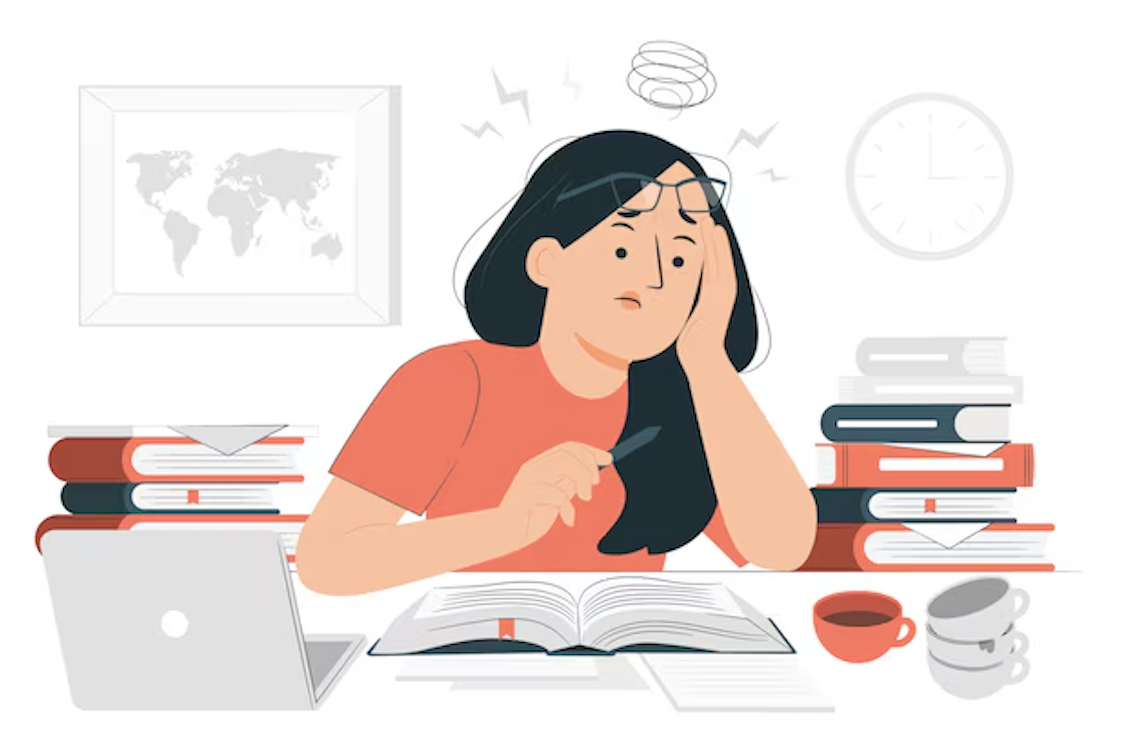
Anxiety is a common psychological condition characterised by excessive worry and apprehension that may be related to one or more situations/events. As per the Diagnostic and Statistical Manual of Mental Disorders, 5th Edition, Text Revision (DSM-5 TR), Anxiety Disorders include Separation Anxiety Disorder, Selective Mutism, Specific Phobia, Social Anxiety Disorder, Panic Disorder, Agoraphobia, and Generalized Anxiety Disorder. The DSM-5-TR also includes Substance/Medication-Induced Anxiety Disorder and Anxiety Disorder Due to Another Medical Condition (APA, 2022).
Anxiety disorders are often categorised based on the source of discomfort or worry; for instance, in Separation Anxiety, the individual may feel extremely anxious about being separated from a loved one or attachment figure. Anxiety can also be viewed as a naturally occurring human feeling or emotion, or a “normal reaction” to a threatening situation. Similarly, academic anxiety can be considered as anxiety experienced, specifically in the context of academic performance or achievement. According to one study, the anxiety level related to certain academic tasks may increase as the student’s academic performance suffers (Huberty, 2012). Specifically in the school setting, research has identified a variety of well-established interventions for managing academic anxiety (Gogol, K., et al. 2016).For many students, academic anxiety can be challenging to cope with. A few evidence-backed interventions that may help such students are listed here:
1. Cognitive Behavioural Therapy:
Cognitive Behavioral Therapy, popularly known as CBT, is a therapeutic approach that embodies the belief that our thoughts, emotions, and actions have a cyclic relationship. For someone struggling with academic anxiety, this approach may prove beneficial by helping them understand the impact of their emotions on their thoughts and their actions, or vice versa. For instance, feeling anxious may lead to having the thought of not being able to perform well in the exam, leading to the affirming action of not being able to give one’s best. This approach may work especially well for building insight into the source of anxiety by identifying cognitive distortions, challenging those distortions, and providing basic behavioural interventions (such as scheduling or reinforcement) to make changes in behaviour. The strongest support for CBT in a meta-analysis was found for anxiety disorders, along with some others (Hofmann, S. G., et al., 2012).
2. Acceptance and Commitment Therapy
Acceptance and Commitment Therapy (ACT) focuses on the capacity to remain present with one’s experiences and act as per one’s own values, even in the face of challenging situations, emotions, or thoughts. ACT offers a different perspective in relation to academic anxiety, by its emphasis on changing how anxious thoughts relate to experiences, rather than focusing on eliminating these anxious thoughts. For example, instead of viewing anxiety as something to be “controlled,” ACT would teach a student to recognise their anxious thoughts, such as “I might fail this exam,” without letting the thought take over completely, followed by actions that are driven by personal values (eg, continuing to study). The approach is grounded in the mindful technique of bringing present-moment awareness while encouraging the setting of goals based on one’s values. In this regard, the approach may help students connect their academic efforts to meaningful values beyond exam results. Just like CBT, the efficacy of ACT in the management of anxiety is also backed by evidence (Gloster et al., 2020).
3. Muscle Relaxation and Somatic Interventions
The presence of a physical component to anxiety has been acknowledged by research (Hoehn-Saric, R., & McLeod, D. R., 2000). Body-based interventions recognise the manifestation of anxiety in physical symptoms such as muscle tightness, an increase in heart rate, shallow breathing, sweating, etc. Students dealing with academic anxiety may benefit from muscle relaxation and somatic interventions as these methods focus on the direct addressal of the physical symptoms of anxiety, offering quick relief in situations that require improved thinking and concentration, for instance, during an exam or a class presentation. Progressive muscle relaxation is a specific technique that involves the systematic tensing and relaxation of different muscle groups, leading to bodily awareness. Similarly, deep breathing exercises and biofeedback (the practice of using electronic sensors to track automatic bodily processes) help activate the parasympathetic nervous system. These approaches can be practised in real-time by students, equipping them with practical tools to manage present anxiety. Research also suggests that relaxation training and biofeedback may be particularly effective in fostering a calm physiological state (Toussaint et al., 2021; Goessl et al., 2017).
Other approaches to managing academic anxiety also exist. However, it must be acknowledged that the treatment or management of academic anxiety calls for a collaboration between educational institutions and psychological professionals. Integrated approaches must be at the forefront of future research on interventions for learning-related stress.
References
- American Psychiatric Association. (2022). Anxiety disorders. In Diagnostic and statistical manual of mental disorders (5th ed., text rev.). https://doi.org/10.1176/appi.books.9780890425787
- Gloster, A. T., Walder, N., Levin, M. E., Twohig, M. P., & Karekla, M. (2020). The empirical status of acceptance and commitment therapy: A review of meta-analyses. Journal of Contextual Behavioral Science, 18, 181-192. https://doi.org/10.1016/j.jcbs.2020.09.009
- Gogol, K., Brunner, M., Preckel, F., Goetz, T., & Martin, R. (2016). Developmental dynamics of general and school-subject-specific components of academic self-concept, academic interest, and academic anxiety. Frontiers in Psychology, 7, Article 356. https://doi.org/10.3389/fpsyg.2016.00356
- Hoehn-Saric, R., & McLeod, D. R. (2000). Anxiety and arousal: Physiological changes and their perception. Journal of Affective Disorders, 61(3), 217-224. https://doi.org/10.1016/S0165-0327(00)00339-6
- Hofmann, S. G., Asnaani, A., Vonk, I. J., Sawyer, A. T., & Fang, A. (2012). The efficacy of cognitive behavioral therapy: A review of meta-analyses. Cognitive Therapy and Research, 36(5), 427-440. https://doi.org/10.1007/s10608-012-9476-1
- Huberty, T. J. (2012). Test and performance anxiety. Principal Leadership, 10, 12–16. http://www.nasponline.org
- Goessl, V. C., Curtiss, J. E., & Hofmann, S. G. (2017). The effect of heart rate variability biofeedback training on stress and anxiety: A meta-analysis. Psychological Medicine, 47(15), 2578-2586. https://doi.org/10.1017/S0033291717001003
- Toussaint, L., Nguyen, Q. A., Roettger, C., Dixon, K., Offenbächer, M., Kohls, N., … & Sirois, F. (2021). Effectiveness of progressive muscle relaxation, deep breathing, and guided imagery in promoting psychological and physiological states of relaxation. Evidence-Based Complementary and Alternative Medicine, 2021, 5924040. https://doi.org/10.1155/2021/5924040
- Jones, A. M., West, K. B., & Suveg, C. (2019). Anxiety in the school setting: A framework for evidence‐based practice. School Mental Health, 11(1), 4–14. https://doi.org/10.1007/s12310-017-9235-2
About the Author