
“Employee Wellbeing is not a part of the organizations; It’s the heart of the organizations”
Employee safety and welfare can be considered the backbone of any organization. Proper working conditions and adequate health facilities should be treated as key priorities. To minimize workplace hazards, appropriate safety equipment must be provided, along with a trained safety and first-aid team. Regular training sessions and clear safety guidelines should also be implemented effectively to ensure a safe and healthy work environment.
To prevent work-related stress, organizations should conduct regular stress management training programs for employees. Recognizing individual strengths and consistently appreciating employees for their positive contributions through praise and rewards plays a main psychological role. Such appreciation not only boosts morale but is also a proven factor in driving an organization’s sustainable growth and long-term success.
Appreciation can take many meaningful forms within an organization, such as recognizing long-term service, honouring employees who introduce innovative ideas that boost productivity, and rewarding unique initiatives that reduce material waste. Acknowledging the best performers within each department and appreciating employees who actively contribute to social service initiatives on behalf of the organization further strengthens a culture of excellence and responsibility. Additionally, extending appreciation to employees’ family members fosters a deeper emotional connection, reinforcing loyalty, motivation, and a strong sense of belonging to the organization.
Building Future-Ready Skills:
Social, emotional, technological, and high cognitive skills will be critically important for emerging industries. Among these, social skills will be going to play a particularly vital role in an Aldriven future. Strong social and problem-solving skills are essential for effective team management and for addressing complex challenges within industries and society. Especially for Gen Z, the development of strong social skills is not just beneficial but essential for long-term professional success in an increasingly automated and interconnected world.
Developing these skills is essential not only for future readiness but also for engaging employees effectively. Training programs delivered through Virtual Reality (VR) are well suited for fresh employees and trainees, as VR provide immersive and practical learning experiences. Regular stress management programs and continuous technology upskilling should be integral parts of employee welfare initiatives. Strong mental well-being enhances focus, learning capacity, and problem-solving abilities, team collaboration, ultimately leading to higher productivity. Emotionally, it also strengthens employees’ sense of connection and commitment to the organization.
Selection of Leaders:
For an organization to function effectively, the Human Resource Department plays a lead role. Ideally, HR leaders should be subject-matter experts. And they should have an ability to emotionally balance the employee and the organization. Their guidance should be grounded in research-oriented thinking and evidence-based approaches.
Effective leaders demonstrate strong team management skills and decision-making abilities, guided by empathy. Employees also expect emotional support and genuine understanding from their leaders. Such emotionally intelligent leadership strengthens workplace relationships, enhances social well-being, and contributes to a positive and productive organizational culture.
Industrial Psychology Perspective:
These verses can be interpreted through the lens of Industrial Psychology, which highlights the importance of proactive behaviour, employee well-being, and sustainable organizational success. A consistent and positive approach to work fosters motivation and engagement among employees. Extending support and care to workers builds trust, psychological safety, and stronger workplace relationships.
Industrial Psychology Perspective:
These verses can be interpreted through the lens of Industrial Psychology, which highlights the importance of proactive behaviour, employee well-being, and sustainable organizational success. A consistent and positive approach to work fosters motivation and engagement among employees. Extending support and care to workers builds trust, psychological safety, and stronger workplace relationships.
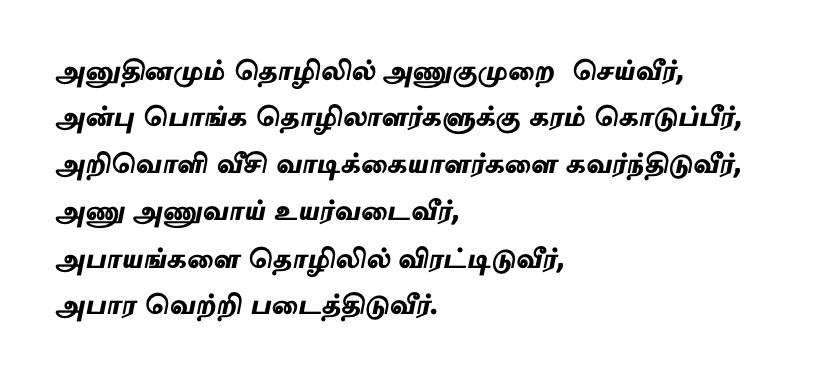
English Translation of the Above Tamil Poem:
Approach your work with purpose each day,
Extend a helping hand to workers with heartfelt care,
Shine with wisdom and inspire your customers,
Rise step by step, growth in every measure, Drive away risks and dangers from your work,
And achieve success that is truly remarkable
A proactive approach in any activity is essential. Without holding on to hesitation, taking timely and decisive action in any field is a true tribute to our profession and the work we do. And Starting at the right time, anticipating future needs, and implementing long-term plans are the first steps toward achieving success in any business or profession.
Properly applying these Industrial Psychology principles in the workplace will strongly support an organization’s step-by-step growth and enable it to achieve exceptional and sustainable success. Employee welfare ensuring both physical and mental well-being represents the true health and wealth of an organization and forms the foundation for long-term performance and stability.
About the Author